Tuesday, March 18, 2014

Facing Down Injustice... A Season of Reckoning

“For to be free is not merely to cast off one’s chains, but to live in a way that respects and enhances the freedom of others.” ~Nelson Mandela
justice+scales.png


CRIME AND INCARCERATION
In the interest of the maintenance of law and order, civil society creates appropriate mechanisms by which it holds those who violate the strictures of the social order accountable. Our courts along with the prison system are a vital part of this process. Persons found guilty of breaking the law often find themselves at the mercy of the Court and it's various agents. Our guiding principle at judgement is that "the punishment should fit the crime". In his inauguration speech President George W Bush stated that: 'A civil society demands from each of us good will and respect, fair dealing and forgiveness.' This is a standard worthy of our remembrance as we reflect on our perceptions of those who find themselves at the mercy of our courts, since our collective perceptions are operational in our eventual treatment of them.
Incarceration is a necessary part of the Justice system. Our society, through its courts, sometimes finds it absolutely necessary to imprison people...some for the rest of their lives. Because of the absolutely critical consequences of sentencing people to serve time in prison, we have a serious responsibility to make sure that our court system functions justly. Avoiding cruel and unusual punishment is a sacred duty that we must be vigilant in upholding. While we set out to appropriately punish offenders for their crimes, we have a responsibility to make sure that we make every effort to rehabilitate those who can be rehabilitated. Most important of all, we have a responsibility to put in place every safeguard against unjust imprisonment. This is a most crucial responsibility as we set out to guarantee the freedom that is idealized in our most celebrated creed.


OUR PRISONS
Not very long ago I worked as a nurse in a couple of our prisons in Pennsylvania. It was, to say the least, one of the most depressing vocational experiences I have ever had. I can state without hesitation that these places are the most dis-spiriting, the most de-humanizing environments that I have ever been in. It is a blatant untruth to speak of these places as experiences in rehabilitation. Anyone who has ever been in one of these facilities will not escape the impression that the culture of our prisons is in essence self-perpetuating. The prison experience as it is results for the most part not in a “correctional” outcome, but in the kind of broken person who will keep going back.
Human Rights Watch in a report in December 2013 has this to say about prison and detention conditions in the USA:
“Prisoners and detainees in many local, state and federal facilities, including those run by private contractors, confront conditions that are abusive, degrading and dangerous. Soaring prison populations due to harsh sentencing laws—which legislators have been reluctant to change—and immigrant detention policies coupled with tight budgets have left governments unwilling to make the investments in staff and resources necessary to ensure safe and humane conditions of confinement. Such failures violate the human rights of all persons deprived of their liberty to be treated with humanity and with respect for the inherent dignity of the human person, and to be free from cruel, inhuman or degrading treatment or punishment.”
One of the foundational underpinnings of our ever-evolving civility is a belief in the inherent dignity of every person. It is this belief that guides our morality. It is what rationalizes our prohibition against discrimination in all its forms. A belief in the inherent dignity of the human person prohibits discrimination based on age, or gender, or race, or national origin. It is what has led us to insist on treating persons with disabilities as deserving of the right to life and liberty, and all the facilities that go with those rights. It is what makes us legislate against cruel and unusual punishment for those who violate the laws of our society, no matter how gross their transgressions. And so we must ask why it is that we are creating the conditions described by Human Rights Watch. A cursory look at the evidence may in fact lead one to conclusions that are not hopeful for our society.
In an economic culture that is intent on culling a profit out of every human circumstance, prisons are designed to be necessarily self-perpetuating. The idea is to keep themselves optimally occupied in order to maximize profits for those who now invest in them. Yes, prisons have become business opportunities. We will come back to this point later. Some people speak of prisoners as “animals” and prisons are designed to make sure they remain as such. In truth I have come to believe that the recidivism that we complain so much about is in fact a desired outcome of those who operate these dens of human degradation.


OUR PRISONERS
Some of us argue that prisoners are the “scum of the earth”, and that they deserve to be treated with the flagrant inhumanity we believe they “deserve”. Such persons are convinced that the focus of confinement should be on punishment, and thus the meaner the conditions of their confinement the better. Rehabilitation, they say, is a luxury not to be wasted on such “scum”. Well I am no neophyte. Neither am I a “bleeding heart” in denial about, or ignorant of the realities of the human condition.
I grew up in Kingston, Jamaica where the proliferation of “garrison communities” has to this day engendered a sense of persistent insecurity amongst the people who inhabit them. These are places where ruthless politicians exploit the survival instincts of their henchmen/henchwomen in pursuit of their electoral goals. These “communities” suffer some of the highest murder rates in the world. The devaluation of life in these circumstances has led to the kind of social destitution in and around them that is described in Damian Marley's “Welcome to Jamrock” :
“Welcome to Jamdown, poor people a dead at random
Political violence, can't done!
Pure ghost and phantom,
The youth dem get blind by stardom... ... ...
To see the sufferation sicken me
Them suit no fit me, to win election them trick we
Den them don't do nuttin at all”
I lived my teenage years in the environment that Damian Marley so aptly describes in his lyrical exposition of the facts of life in these violence disposed ghettos. By the time I was 21 years old, many of the boys I had gone to elementary and secondary/high school with were either dead or in jail. They had become perpetuators or victims, all equally susceptible to the destructive wrath of the knives and bullets of the criminal/political tribalism around them.
I have been robbed, and shot at. I have had loved ones raped and murdered. I have been called a “slave” for believing in the virtues of hard work by those who chose to be “thugs”. I have been caught up in curfews where a policeman told me to “run” so I would become a target of his trigger-happy... murderous inclination. I believe am alive today because something greater than the fear in me made me stand firm against this prevalent inhumanity. Scary as it was, I learned to walk through it. I know about the corrupt influence of politicians, and cops, and preachers...
There are evil people in the world, and no amount of naïveté or pseudo-liberal idealism will, or can change that reality. I make no excuses for those who choose to cultivate their depravity with excuses about being poor or disadvantaged. I grew up among the poor and disadvantaged, and I know that decency and industry was as much a part of our experience and aspirations as it may have been among some of those experiencing the abundance that we longed for. I also know that we did not have the quality education and training facilities around us that the privileged were exposed to. Neither did we have the resources to bribe the police and politicians and other servants of the status quo to gain access to the advantages that the monied around us had.
Despite the deleterious influences around me I have always seen my life in terms of making a positive difference in my world. By the time I was 18 years old I had boiled down my vocational choices after high school to either law enforcement or the priesthood. I chose the church because I was convinced I would be no good at taking orders. After four years of seminary I found myself in a vocational crisis that led me to the couch of a renowned psychoanalyst who, after many sessions, concluded that my personality was most suited to work in a prison. I left her office laughing, I don't know why... I remember that I was very sad.
The socio/cultural challenges we face are are at times dire. There are people who for various reasons do not share civil society’s qualms about "screwing-up" the moral/social/economic order. Yes, there are elements out to create havoc and destruction who are possessed of a seemingly unfathomable anti-social black hole. They will not be redeemed...try as hard as we could. Despite our best efforts, society will end up having to protect itself from certain hell-raisers. Our society needs to be protected from sociopaths and homicidal maniacs. On that we can all agree. There is no doubt that there should be special places for such characters.
The factors contributing to criminal behavior are many, some more complex than others. There is no lack of research in this subject. Our social scientists have accumulated a vast body of work on the subject. Without ignoring the many factors observed by those who look at the phenomenon of criminal behavior, the criminal justice system must function to prosecute those who violate law and determine what just punishment should be meted out.


PRISONER or CAPTIVE
Definition of a prisoner: a person legally held in prison as a punishment for crimes they have committed or while awaiting trial.
Definition of a captive: a person who is enslaved or dominated or imprisoned.
One major challenge of the court system and those who direct its operation is to make judgements about the crimes for which a person should be incarcerated. Another equally challenging responsibility of the system of Justice is to guard against the unjust imprisonment of people. It is the latter of these two concerns that is my main focus here..
It is a fact that the justice system has been in a number of circumstances, perverted to serve the economic interests of corrupt lawyers and judges. It is also a fact that sentencing has become a vehicle for filling the jails with people who are seen as nothing more than cogs in the wheel of an “industry” driven by a for profit motive. In light of these facts we must ask serious questions about the motivations behind the sentences handed down by some of our judges.
Are we locking away people in our prisons who should be more justly and appropriately placed in programs focused on social, medical, and psychological rehabilitation? Furthermore, are we committing a greater harm by placing them at the mercy of those whose goal is to make a profit at the expense of the life of the socially and economically disadvantaged? Are many of those we have now lumped in as “prisoners" more appropriately captives of an essentially unjust system?
Consider the following from an article by Kate Henderson, and published in Liberty Voice in December 2013.
“Mark Ciaverella Jr was a Judge in the Pennsylvania Juvenile Court, Luzerne County, who abused his position to sell juveniles into prison facilities as “Kids for Cash.” When it came to his turn to be sentenced he was given almost thirty years behind bars... ...This man took money in exchange for the incarceration of thousands of children and young adults. The developer who owned the private prison system paid him “under the table.” These highly illegal and immoral earnings amounted to over a million dollars in Ciaverella’s...pocket.
Convictions he made between the years of 2003 to 2004 have all been overturned, amounting to over 4,000 cases. He consistently violated the constitutional rights of youngsters, including their right to have legal counsel and their right to enter an intelligent plea.  One of the youngest persons he passed sentence on was only ten years old. His sentencing was rapid, and invariably severe. He needed to keep that prison packed with kids. Non-violent, insignificant and even nonsensical “crime” was penalised the same way."
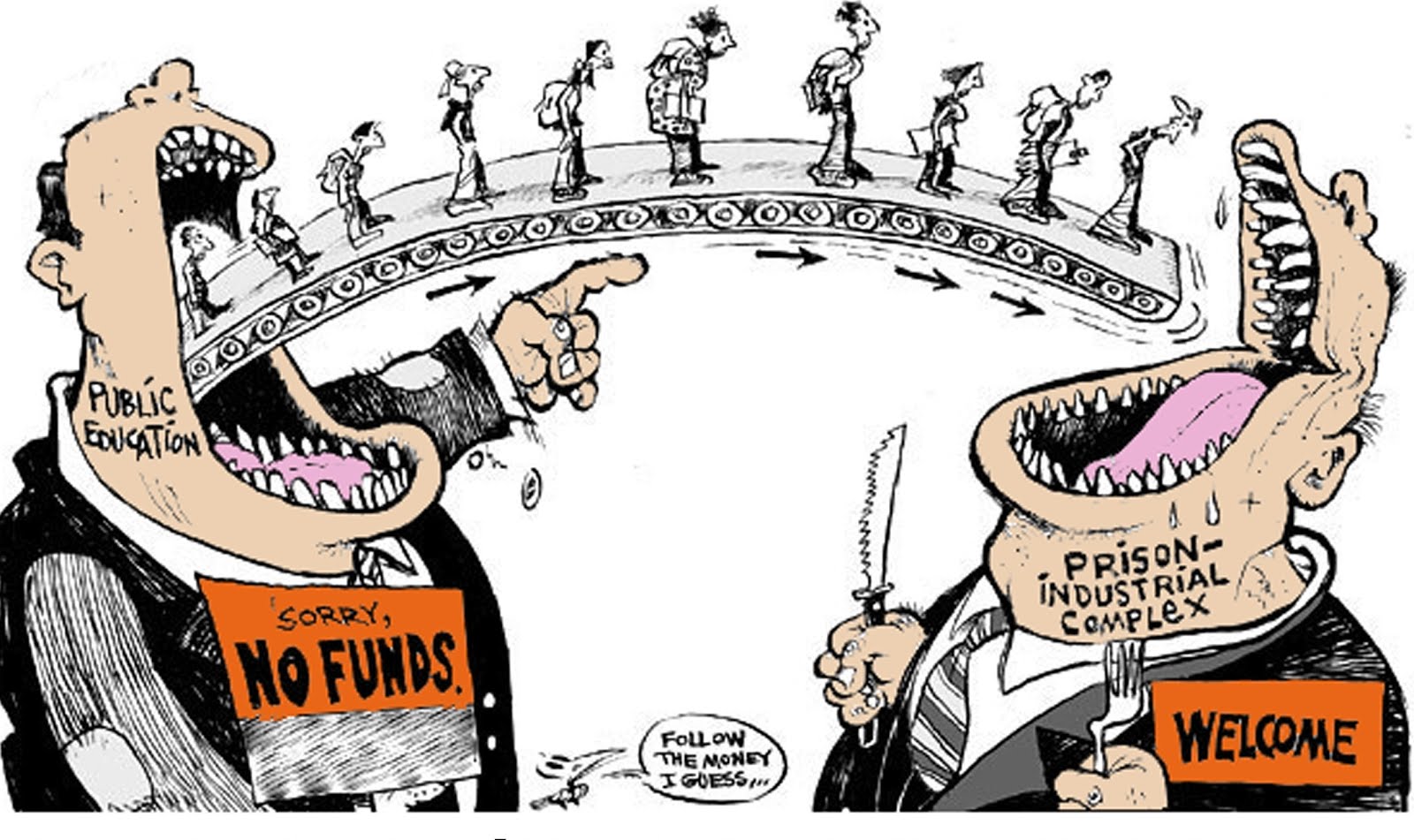
There is reason to believe that Ciaverella is not alone in this “enterprise”. The proverbial “love of money” is what drives the judicial indiscretion of many of our judges. That, combined with their political ambitions, has created a slippery slope by way of which we have managed to create a level of incarceration not seen anywhere else in the world. The “land of the free” has become the home of the imprisoned. How could this be? What accounts for this existential contradiction?
School-to-Prison-Illustration.jpg


THE PRISON INDUSTRIAL COMPLEX
Since the 1970s the prison population in the USA has grown by leaps and bounds. According to the International Centre for Prison Studies:
“No country incarcerates a higher percentage of its population than the United States at 716 per 100,000 people”.
This fact stands out in light of our claim to being the "beacon of Freedom”. It is necessary that we ask why... Why do we lock away our people at such an outrageous rate? Unsurprisingly the answer to this question may lie at the very heart of our socio-economic ideal. At the very core of this issue is a version of capitalism ...expressed as unbridled, rapacious greed.
Vicky Pelaez writes the following in an article titled “The Prison Industry in the United States: Big Business or a New Form of Slavery?” :
“There are approximately 2 million inmates in state, federal and private prisons throughout the country. According to California Prison Focus, “no other society in human history has imprisoned so many of its own citizens.” The figures show that the United States has locked up more people than any other country: a half million more than China, which has a population five times greater than the U.S. Statistics reveal that the United States holds 25% of the world’s prison population, but only 5% of the world’s people. From less than 300,000 inmates in 1972, the jail population grew to 2 million by the year 2000. In 1990 it was one million. Ten years ago there were only five private prisons in the country, with a population of 2,000 inmates; now, there are 100, with 62,000 inmates. It is expected that by the coming decade, the number will hit 360,000, according to reports."
Addressing the same issue, Andy Kroll writes the following in an article titled “This Is How Private Prison Companies Make Millions Even When Crime Rates Fall” published in Mother Jones magazine, Sept 2013:
“We are living in boom times for the private prison industry. The Corrections Corporation of America (CCA), the nation's largest owner of private prisons, has seen its revenue climb by more than 500 percent in the last two decades. And CCA wants to get much, much bigger: Last year, the company made an offer to 48 governors to buy and operate their state-funded prisons. But what made CCA's pitch to those governors so audacious and shocking was that it included a so-called occupancy requirement, a clause demanding the state keep those newly privatized prisons at least 90 percent full at all times, regardless of whether crime was rising or falling.
Occupancy requirements, as it turns out, are common practice within the private prison industry. A new report by In the Public Interest, an anti-privatization group, reviewed 62 contracts for private prisons operating around the country at the local and state level. In the Public Interest found that 41 of those contracts included occupancy requirements mandating that local or state government keep those facilities between 80 and 100 percent full. In other words, whether crime is rising or falling, the state must keep those beds full.”


SET THE CAPTIVES FREE!
Stop for a moment and let that sink in... The prison industrial complex wants the jails full even if crimes numbers are in decline. What are the implications of this demand for the way our justice system operates? It is time for a critical examination of the process of what is blatantly an “injustice system”. Can a society that ignores this fact escape its consequences? When our aspiring candidates for political office talk about being “hard on crime”, let us loudly interrupt them and ask them how much money they are getting from this prison industrial complex. Are they and the judges we elect the compliant cronies of the system of injustice which now exists to target the poor and underprivileged in our communities...especially our communities of color? Paul Waldman writing in The American Prospect observes the following:
"... you can't talk about prisons without talking about race. African Americans in particular are over-represented in prisons; though they are 13 percent of the population, they made up 38 percent of the population of state prisons.... The crimes that landed them there, however, are not too different from their white and Hispanic counterparts. Eighteen percent of blacks in state prisons were convicted of drug crimes, compared to 15 percent of whites and 17 percent of Hispanics."
In addition to the disproportionate number of persons of color in our jails, it is also a fact that the US imprisons more women than any other country. This raises other disturbing questions about the political culture being perpetuated here. Think for a moment about the history of the disenfranchisement of women and minorities in this country's politics. In a democracy such as ours one may ask... in fact must ask... who benefits from the disenfranchisement of this part of the potential electorate which is disproportionately affected by our present policies on incarceration? Is the excessive incarceration of women and people of color a way of thwarting the process of democratization? Does it tilt the balance of electoral power in favor of the same influences that historically wanted exactly that state of affairs? These are questions worthy of further examination. Is this in fact jerrimandering via incarceration?
Let us be very clear about what is at stake here. There are inescapable consequences of this kind of injustice. The institutions in our communities must begin to take this issue to heart. We must do more than is being done to conscientize our fellow citizens about this problem.The proliferation of “prison ministries” focusing on saving the proverbial “soul” is unlikely to “change the hearts” of the captives in this new system of slavery. The prisoners are more aware than the preachers that the dichotomy assumed between their physical and spiritual needs is a false one. The “ship” called “Jesus” is not being employed to carry these people away from the degradation and misery and disenfranchisement created by a system of greed and it's corrupted agents. The true “gospel of salvation” that is appropriate in this circumstance is predicated in the powerful, sometimes controversial message of the Prophet Isaiah:
“The Spirit of the Lord God is upon me,
Because the Lord has anointed me to bring good news to the afflicted;
He has sent me to bind up the brokenhearted, to proclaim liberty to captives
And freedom to prisoners;
To proclaim the favorable year of the Lord the day of vengeance of our God;
To comfort all who mourn,
To grant those who mourn in Zion,
Giving them a garland instead of ashes,
The oil of gladness instead of mourning,
The mantle of praise instead of a spirit of fainting.
So they will be called oaks of righteousness,
The planting of the Lord, that He may be glorified.” (Isaiah 61:1-3)
When Yeshua (Jesus) adapted this passage to the goals of his own ministry in Nazareth, the place where he grew up, those representing the status quo were so enraged with him that they attempted to “throw him off a cliff”. It didn't matter that they were “in the synagogue on the sabbath day”. Let us be crystal clear...there must be no collusion between those who stand for Righteousness/Justice and those who facilitate the oppression of the poor. Persons unjustly held and treated like chattel in an industry that predicates it's future success on their dehumanization need us not just to speak up, but to act to bring about the change necessary to set them free.
Yes... Salvation is a powerful action word, not a salve in the plantation’s religious balm yard. The hunger for a salve by which people try to cope with the stressors around them is all too real. It has fed the specter of addiction that plagues so many lives all around us. The results of this "hunger" and those who feed it are manifest in our prison population.
Toward the purposes of bringing good news to "the afflicted", it would serve us well to work toward the decriminalization of drug addiction. We can begin this process by decriminalizing drugs, just as we did alcohol, and instituting rehabilitation programs at the community level that are geared toward the needs of those who can't afford the high priced services geared to rich addicts...who do not usually  end up in jail.  
Our so-called "war on drugs" is for every intent and purpose an out and out assault on poor addicts who need our help. It is in fact a "war" that enriches dealers and police departments and the builders of jails. This is one of the dirty little secrets of this whole "business"... And a nasty , stinking one at that. How many law enforcement officers and departments want to see this war end when in fact it is a cash cow for them? How much of the drugs on the street corners of our inner cities actually come from the evidence rooms of local precincts? How many of the murders paraded before us on the Sunday morning news are committed by police who set out to victimize local "drug dealers"?
We can begin the empowerment of the "broke" and the "broken hearted" by building training facilities that are geared toward equipping the economically depressed with marketable skills. Nationwide, three-quarters of our prison population are high school dropouts. Education, not incarceration, should be our focus. More modern schools...not more modern jails, should be our priority. Let us explore the possibilities of giving "garlands" not "ashes" to those who are disadvantaged among us. Can we make them partners in the building up of Zion, and thus cultivate "mantles of praise instead of a spirit of fainting"? I believe we can. I believe we must try.
The time is now when we must insist that our government provide the resources for the rehabilitation of the redeemable among those who break the law, rather than hand them over to be exploited by those who see them only as a means to make lots of money. The belief that warehousing these souls for profit somehow makes our communities better turns the truth on its head. How can we work to bring out the worst in the disadvantaged among us, and expect that this will not come back to haunt us? Bringing out the worst in them is what our prisons do...more often than not.
Our top law enforcement officer Attorney General Eric Holder, acknowledges both the failure of our prison system as it is and the fact that drug addiction is in fact a public health crisis in this country. It is a travesty of Justice that we continue to address a public health crisis by imprisoning its victims. It is time to wake up from the nightmare of our delusions and collective insecurities.
Good news to the captive is sometimes bad news for the captor/investor/immoral politician. So be it. We can no longer bury our heads in the sand and remain complicit in the dehumanization of our brethren. When we look at our 401k statements in the future, let us ask whether or not we are participating in the oppression of our neighbors and their children by investing in the prison industrial complex. The time has come to put resources behind our proclamations! How many of our municipalities have invested in this degradation of souls through their pension funds? Should we continue to support a political process and politicians opting to take the easy way out by “farming out” the incarceration of those who break the law?
Ultimately it is centers of production that will fuel the security and prosperity of our communities, not detention centers. Again, let us invest in the future of our communities through the empowering vehicle of a good education. Let us build up or schools, not build more prisons. The viability of our communities is a direct function of the viability of our collective humanity, not some crass notion of brute force exercised by those who pretend they wanna be "tough on crime". Enough of the lazy-think of an opportunistic and lewdly gratuitous culture.
The ever resilient Nelson Mandela, patriarch of a new and revolutionary consciousness, articulates a vision of our humanity that we must all necessarily embrace in our efforts at building viable communities. Our communities, he insists, must be built by people who realize that to guarantee our own freedom we must respect and do everything we can to enhance the freedom of others. A society that predicates it's security on the continued oppression of people will never be truly viable. Indeed it is actively sowing the seeds of its own demise. There is a great body of evidence pointing to the fact our prison system functions to create the very recidivism it claims to exist to deter. We reap what we sow... So JAH say!!!
At the very core of our idealism as a nation is a philosophical insistence that "all persons are created equal, and are endowed by their Creator with the right to life, liberty, and the pursuit of happiness". This is the central idea informing the exceptionalism we claim as a nation. Those who insist on the validity of the fundamental ideals informing our nation's origins, it's growth and  it's development; must never forget that our Faith has its genesis in a moral and ethical relationship with the God of Moses. That would be HIS/HER voice calling us from the “burning bush” of Justice. The Power from which that voice emanates is defined in the reality that we are inextricably connected in our "being", and are therefore essentially affected by all the circumstances that touch each of our lives.
The voice of our supreme moral and ethical Source declares in no uncertain terms that we must take off the boots of complacency which weigh us down in the muck of injustice. Those boots keep us from advancing overdue liberty-promoting actions toward our fellow persons withering away as captives of an unjust system. These captives yearn for deliverance from the liberty-suppressing, life-thwarting circumstances prevalent around them. The undeniable dynamism of that voice holds our feet to the fires of Justice. Cover our ears as we might, that same voice echoes disturbingly from the distant “wilderness” of our beginnings as a nation. A nation founded on the ideals of Liberty, Equality, and Justice for all.
Those who would articulate the dynamic instructions of our moral core are required to have an exegetical moment that is ontologically meaningful. Repeating platitudes that comfort those who choose various convenient states of inaction while ignoring the need for change, will only cement us in a place of cultural and spiritual decadence. Ours is a Faith resonating in the powerful vibrations of the “Gong”...Robert Nesta Marley:         
"Jah come to break downpression,
Rule equality,
Wipe away transgression,
Set the captives free... Set the captive free!... Set the captive free!"  (From “Exodus”...)


ONE LOVE!
R.A.G.
* Images / illustrations courtesy of Google Images


Friday, February 28, 2014

True Faith or Idolatry?


The following was written in response to a recent posting by blogger Walter Rhett on the now defeated attempt by the religious right in Arizona to codify discrimination against persons whose sexual orientation is different from theirs. This piece was published in the News York Times comment section by Mr Rhett in response to an article written on the same subject by columnist Gail Collins on February 27th 2014.

  1. royagraham says:
    A faith that validates the insecurities of its adherents is rightly seen as idolatry. It is , as you say, a function of the looking glass syndrome. A faith that challenges us to look beyond our own insecurities toward the building of the kind of community where we see each other in terms of the justice of laws that protect each other’s right to the pursuit of happiness is what ultimately serves us best. That, is a transcendental faith. Hate is a byproduct of the over indulgence of our insecurities. The religion of bigots reeks of its foul presence.
     

Saturday, February 22, 2014

Not For Praise or Glory

Each day presents new opportunities to make ourselves and our world better. We should live into these opportunities not for praise or glory, but just to give expression to the virtue that is inherent in that particular desire itself. To give of ourselves in ways that lifts others up is innately fulfilling. To shine a light in the dark spaces around us, is to make our own journeys a little less precarious. There is a certain wisdom in not seeking the limelight that so many others crave. It is the same wisdom that counsels us to the effect that "it is more blessed to give than to receive". Let us give the best of ourselves each day knowing that by doing so we enrich our own lives in ways that no amount of praise or money can.


Thursday, December 19, 2013

A Season For Balancing The Scales

A Season for Balancing the Scales scales

"When I feed the poor, they call me a saint; when I ask why they are poor, they call me a communist." Archbishop Dom Helder Camara

THE 1/204th HUMAN

There is an alarming lamentation among economists, social and political commentators, and progressive voices for economic justice, that while household incomes have essentially remained stagnant since the mid 1980s, in the same period corporate profits and executive compensation have grown at mind-boggling rates. Fifty percent of income resources now go to the top ten percent, while the other fifty percent is shared by the bottom ninety percent. This lamentation should get our attention because of the ramifications of this kind of inequity for the stability of any society. Peace does not proliferate where justice has no foundation. This is a fact of life...everywhere.

Joseph E. Stiglitz, a Nobel laureate in economics, a professor at Columbia and a former chairman of the Council of Economic Advisers and chief economist for the World Bank has observed the following:

"Our skyrocketing inequality - so contrary to our meritocratic ideal of America as a place where anyone with hard work and talent can "make it" - means that those who are born to parents of limited means are likely never to live up to their potential. Children in other rich countries like Canada, France, Germany and Sweden have a better chance of doing better than their parents did than American kids have. More than a fifth of our children live in poverty - the second worst of all the advanced economies, putting us behind countries like Bulgaria, Latvia and Greece."

In a national culture where American exceptionalism has become the cliched boast of those whose political ambitions drive them to side with those who have a vested interest in the maintenance of the status quo, we must ask ourselves whether or not this is the “exceptionalism” we want to engender going forward. What can we expect to be the future of a society in which the social, political, and economic ambitions of the few creates the kind of disparity that drives the majority toward a veritable cliff of hopelessness? Our nation’s destiny is without doubt severely compromised when the hope of the few creates despair among the many.

Zoe Carpenter, writing in The Nation, observes the following:

“It’s no secret that this sort of economic inequality is increasing nationwide; the disparity between America’s richest and poorest is the widest it’s been since the Roaring Twenties. Less discussed are the gaps in life expectancy that have widened over the past twenty-five years between America’s counties, cities and neighborhoods. While the country as a whole has gotten richer and healthier, the poor have gotten poorer, the middle class has shrunk and American’s without high school diplomas have seen their life expectancy slide back to what it was in the 1950’s. Economic inequalities manifest not in numbers, but in sick and dying bodies.”

The stark reality of our national life is that the growing inequalities in our economy are sadly expressed in crime and violence, in diminished access to quality education, and in the diminished health and life expectancy of the many who struggle to “make ends meet”. It is convenient for pompous conservatives to point the finger at the presumed “immorality” of the disadvantaged. By objectifying the unwed parent they are able to direct attention away from more substantial issues amongst us. For example, we might be asking questions as to whether it is moral for a fast food chain to bank billions of dollars in corporate profits while denying its workers a livable wage.

We must not allow ourselves to be distracted by the well developed sleight of tongue of our socio/economic/cultural detractors, who want to talk about individual responsibility while corporate entities get to call their lack of a collective moral orientation “success”. It is time to ask ourselves some hard questions about the kind of nation we are. Is community only essential when we want to mobilize the children of the working class to shed their blood in wars that have their raison d’etre in the undisclosed economic motivations of the neoconservative class?

Jesus of Nazareth whom many conservatives worship as their “Savior” rebuked those pointing their fingers at those who are too disadvantaged to effectively answer with the instruction, and here I paraphrase... Remove the log from your own eye before you talk about the speck in the eyes of others! As for this Jesus, he was a man surrounded by the working class. He himself is believed by many to have been, among other things, a carpenter.  This was a man who understood the predicament of the Mary Magdalenes of his world. He did not look down his nose at fishermen among whom he moved easily, his buddy Peter being one of them. He got Matthew, a tax collector, to leave a profession that many saw as oppressive and join him in the work of liberation. Jesus stood up for the poor, as his embrace of that well read mission statement from Isaiah 61 shows. The “good news” he proclaimed to the poor was bad news for those who gained from keeping things the way they were.
  There is no doubt in my mind that today’s conservative would condemn this Nazarene’s “social gospel” as unadulterated Marxism. His relationship with the political leadership and its economic partners was by no means a comfortable one. Remember that incident with the “money changers” in the temple? These economic vampires were using their monopoly of the currency supply to make exorbitant profits, charging “whatever the market would bear” for coins that the people needed to pay their annual Temple tax. Jesus physically threw them out of the Temple after branding them “thieves”. Days later these same bankers called for his death. How dare he do anything to compromise their hard earned profit margins?

According to Bloomberg, the average CEO makes 204 times the salary of the average employee. Is this what we mean in fact when we spout off about “American exceptionalism”? How long will civility hold when the social contract engendered by our economic relationships continues to guarantee the fecundity of the few at the expense of the many? Simply put, how long can we expect that the poor will accept that their lot in this life is to be fodder for the ambitions of the rich?

THE CASE FOR AN “EXCEPTIONAL” WHOLENESS

In this season of “goodwill toward men” it behoves us to stop and reflect on the foundational ideals of our civil society. The loud voices of conservatism among us want us to believe in their version of the Judeo-Christian value system. The problem is that they are either ignorant of, or in total denial about the prophetic voices that have given life to this tradition throughout its history. Have the conservative pontificators among us read Amos, or Isaiah, or any of the prophets for that matter? Have they not heard Amos’ appeal to “let Justice roll down ...”? I speak with the prophets when I declare that we must not have our voices co-opted in the efforts to further oppress and marginalize the disadvantaged among us.

In light of the fundamentalism which insists that we must give prominence to the Biblical foundations of our nation’s origins, it becomes imperative that we raise some fundamental questions about those foundations. What, we must ask, are the social ramifications of a belief system that assumes the “fatherhood” of “a common Creator”? In the words of Cain... Am I my brother’s keeper? Do I have the right to demand that I be treated as a “fellow person”?  In the tradition of Martin Buber who was a prominent twentieth century philosopher, religious thinker, political activist and educator; shall we cultivate amongst ourselves “I-thou” rather than “I-it” relationships. Do we truly believe that “all persons are created equal”?

Religious belief is by no means separable from the anthropological assumptions of the faithful. People in fact create gods in their own images. Our religious ideals therefore bear the indelible imprint of our social, economic, and historical bearings. For this reason it is a semantically perilous exercise to posit a conversation about a just and civil society with assumptions about commonalities in religious belief. As I have stated elsewhere, our theology is, for the most part, the deification of our anthropology. The peril of religious dialogue is therefore its inherent subjectivity. Given this fact, it is not surprising to find that even the highest authority in any religious system will be verbally and otherwise assaulted by the faithful of the church of status quo ethics and economics. Such authorities include even the Successor of Peter.

The new Pope has garnered much press for the fresh new approach he has brought to leadership at the Vatican. His theological praxis is no doubt informed by the experiences he had as a pastor among the poor in Latin America. Like ArchBishop Dom Helder Camara, he is no stranger to the plight of those who struggle daily to eek out a living in desperate circumstances. Pope Francis has repeatedly called for greater efforts to lift up the world’s poor. The pontiff has this to say in his most recent encyclical:

“Some people continue to defend trickle-down theories which assume that economic growth, encouraged by a free market, will inevitably succeed in bringing about greater justice and inclusiveness... This opinion, which has never been confirmed by the facts, expresses a crude and naive trust in the goodness of those wielding economic power and in the sacra­lized workings of the prevailing economic system.”

The fact that this statement expresses the doctrinal position of the Church way before this Pope came to office has not saved him from the venom of the icons of our current conservatism. The standard satanization has been pronounced against him. MARXIST! The “gates of hell” may not prevail against the “Rock” on which the Church is built; but the missile “Marxist!” has a certain philosophically destructive appeal among the religious masses.

It is ironic that in a culture where the God of the prophets tells the oppressors of the poor to go to hell with their “sacrifices” and their other religious observances, these same oppressors never cease to warn the poor about “a godless ideology”. I am reminded of the Epistle of John where it is unequivocally stated, and here I paraphrase again... If a man says he loves God whom he cannot see, while he is oppressing his brother whom he can see... That man is a LIAR. So, one may ask on the basis of this declaration, whose is the godless ideology?

President Barack Obama has been making the case for increasing the minimum wage.The federal minimum wage currently is $7.25 an hour, or about $15,000 a year. The President has indicated his commitment to back a Senate measure to increase the minimum statutory pay to $10.10. In the process he too has had to endure the satanization ...“MARXIST!” because of his efforts to improve the lot of the widow and the orphan. He understands that this kind of critique “comes with the territory”. Those of us who support the efforts of this President to make ours a more just society have no doubt that History will absolve him.

JUSTICE IS THE ONLY TRUE WORSHIP

As a student of the Judeo-Christian tradition, it is my conclusion that every 8th century prophet would have to endure the satanization of the likes of Rush Limbaugh in their stand against the economic/cultural status quo. In the struggle toward a more just society we must stand up to the the pseudo-intellectualism of the moral halfwits among us. We must not sit idly by while the apostles of what His Holiness calls “the sacralized workings of the prevailing economic system” hold court. Furthermore, we will not allow the voices of the prophets to be drowned out by their heresy.

This is a season to participate meaningfully in calling the poor into a realization of the power they have to change the bleak and seemingly hopeless circumstances that face them. It is time for the worker to understand that their worth is much more than 1/204th of that of the CEO’s, who smiles at them and declares his/her feigned charitableness by handing out hormone inflated turkeys at Thanksgiving and Christmas. The God of Righteousness is with us. Listen as He/She speaks: Amos 5 vs 21-24

“I hate, I despise your feasts,    and I take no delight in your solemn assemblies. Even though you offer me your burnt offerings and grain offerings,    I will not accept them; and the peace offerings of your fattened animals,    I will not look upon them. Take away from me the noise of your songs;    to the melody of your harps I will not listen. But let justice roll down like waters,    and righteousness like an everflowing stream.”

The resetting of our priorities to which we are directed by this rebuke has its very essence in the reality that to “do justly and to love mercy” is in fact the ONLY meaningful religion. The virtuousness of this statement is however not reserved for the religious. Prosperity does not happen in a social vacuum. The law of the jungle might have a certain appeal to the greed induced coma that typifies the behavior of those who have blocked the need to be “righteous”, but it only sets them up for destruction by the hosts of the aggrieved. The “jungle” is by no means a desirable social ideal. Ultimately our hopes for progress are rooted in a fundamental understanding of the kind of community where justice is a shared value. A society in which I-Thou takes the place of I-it in our socio-economic interactions. It is the need for this kind of community that beckons us into a season for balancing the scales.

One Love,

R.A.G.

Sunday, July 14, 2013

Of Paradise Despised...The killing of Trayvon Martin and the shooter's acquittal

On Saturday the 13th of July 2013, George Zimmerman of Sanford, Florida was found not guilty on all charges in the shooting death of seventeen year old Trayvon Martin. Zimmerman, a neighborhood watch volunteer, shot and killed the teenager in a confrontation that all reasonable analysts agree should have been avoided. 

The shooter Zimmerman was only arrested after the incident received national attention that resulted in mass protests across major cities in the US against the inaction of the Sanford police department. His trial generated a national discussion on the part that race played in this unfortunate incident; and also on the availability of equal justice in our society. 

Many gathered around the courthouse as the nation awaited the decision of the sequestered jury. Those gathered ranged from members of the New Black Panther Party demanding justice for Trayvon, to friends of Zimmerman hoping for his acquittal. The jury who were all white except for one, found George Zimmerman not guilty on all charges. 

It is the morning following this verdict, and emotions run the gamut from elation among Zimmerman sympathizers; to anger and depression among those who feel the pain of Trayvon's family. Many anticipated some social upheaval to accompany this kind of verdict; but except for some incidents in California, the nation has remained calm. 

The angst that this event has generated is palpable. Many would like to forget the role that a history of racial animus has played in how we perceive events like this, but there can be no mistaking the fact that our responses are conditioned by this history. Just over a generation ago, apartheid was the operational dynamic in social and legal happenings in the South. As uncomfortable as some are, being reminded of this.... It remains a frame of reference in the interpretation of this type of unfortunate occurrence. 

As we continue to reflect on this verdict, the events leading up to it, and the realities that continue to inform the quality of our interpersonal relationships; let us do so remembering the sacred trust that we must assume toward each other if we are to build the kind of community that expresses the equality of all men in the eyes of our Creator. 

I humbly submit these verses from my book of the same name, “Of Paradise Despised…and lives that bought into a lie”, as a meaningful aid in our further reflection. 


Shanty towns
Of heated browns …
Blighted spirits weighted down
On bended knees
To hierarchies
Of powers in conflict that compete
For the loyalties of those oppressed
By the hardened heart of wickedness
And their own sense of void …

Wanton
Wasted
Brokenness
That looks at life through blood-tainted eyes …
Rancid stench of wretchedness …
Dark arresting passions
Of a sinful nakedness
Raging red
Till death and hell
Confirm the dread-full truths
Of paradise despised
And lives that bought into a lie …

And when we sorrow for the lives of our sons
Who indulge in the violence of their mutual despair
Will our tears yet quench the barrenness
Of this heated state in which we live …

And can we stop this crimson rain …
This predestined clash of conflicting loyalties …
If we replace the shanty towns
With fertile places unconfined …

And on this rise
From which we survey
The woe-begotten aftermath
Of a Megiddo inspired conflagration
We retire to wipe our tears
And find a place
To build a house of hope
Through which flows
The eternal spring
Of that love
That softens hearts
Restoring hope
And heals the brokenness of every passionate soul


One Love,
Roy

Sunday, June 16, 2013

'A Season For Being Grounded'

The following piece was initially posted for the Summer 2013 issue of  "Figs In Season"  (www.FigtreeEnterprises.com).  
"Figs In Season"  focuses on inspiration for both our chronological and our kairotic journeys:

'A Season For Being Grounded'


GROUNDED : being mentally and emotionally stable : admirably sensible, realistic, and unpretentious. (Merriam-Webster)


Reflecting on the ordinary events and circumstances of our everyday lives can, with the right frames of reference, produce deeper insights into our existence. In fact, the extraordinary “revelations” produced by many of our sages are the results of a deeper analysis of events and circumstances that most of us bypass, or otherwise gloss over in the course of our own experiences. We can connect with our "deeper” selves by cultivating a more acute awareness of the implications of ordinary events and circumstances that occur daily in the various facets of our living. A deeper appreciation of the ordinary lays the foundation for better decision-making. It allows for extraordinary interventions on our part, when faced with critical situations.

Take for example the "wisdom of Solomon" as demonstrated in the case of two women who came before him in a dispute over a child. Both women had given birth to sons within a short time of each other. While they slept one of them overlaid her baby, resulting in his death. Now they were before the king, each claiming that the surviving child was hers. After considering the dilemma before him, the king proposes to split the surviving child in two with his sword and give each woman a half of the child. A horrendous proposition, but one readily approved of by the woman who was clearly not the child's mother. 

What mother in her right mind would say yes to such a thing? In a culture where the definition of womanhood is tied to the ability to bear and raise children, some women become desperate about attaining and maintaining that status. But even in that desperation the bond engendered between a mother and child during the course of gestation remains more often than not, durable and unmistakable. A caring mother would never casually or otherwise agree to such a proposition to resolve this or any other crisis involving her child.

The other woman, heartbroken and going out of her mind about the possibility of such a fate for her baby, begged the king to give the child to this other heartless person in order to save its life. This was a demonstration of that motherly affection which we know to be almost universal, and with which most of us can identify. The king, recognizing her motherly instinct, gave the child to this woman. She had, without doubt, authenticated her motherly claim by being willing to save her child's life even if that meant she was going to lose custody to this desperate person. 

The king’s action was that of a wise judge. Solomon demonstrated wisdom derived from an in-depth knowledge of his society’s norms, a real appreciation of the dynamics at work in the socio/cultural environment, and an intimate connection with the complex workings of the human mind and heart. We rightly applaud such great judgement. But as we do so it is vital to realize that each of us can give ourselves the benefit of this kind critical ability. We do so by cultivating a deeper awareness of the world around us and its workings. 

To get a real grasp of the world outside the one we inhabit we must become daring. We must be willing to delve beneath our own ingrained superficiality. It demands that we unlock the gates of our old familiar comfort zones, and venture into the uncomfortable realm of mindsets and experiences that are foreign to our own experiences and unkind to our vulnerable sensibilities. Solomon cultivated this critical ability. To be a good king he had no choice. His was a groundedness wrought in the inconvenient, and at times agonizing business of governing. This is what it takes to be the masters of our domain.

Not too long ago I had an opportunity to do some reflection on certain events in my experience. The circumstances and demands of my analysis were nowhere as critical as in Solomon's; but they remain meaningful for me nonetheless. I hope you will find the following observations useful, as I invite you to ride along with me in this act of reflection-sharing.

Above the clouds

So here I was cruising at thirty-two thousand feet on a flight from Atlanta, Georgia to Philadelphia, Pennsylvania. My flight originally scheduled for this time yesterday was cancelled without notice. A day later, with the sun streaming through the windows of the business class cabin, it is going to take at least an extra half-hour because we have been re-routed. This trip will add an extra two hundred or so miles, but it will get us around weather that might not be conducive to safe, comfortable flying. 

The pilot explains that our new plan “will take us north toward Ohio, ... and then we will eventually approach our destination from the south-west...” instead of our usual swipe across the Delaware River. Small price to pay, I thought, I just want to get there...and in one piece. In the final analysis we will readily accept changes in our lives, and to our plans, when we realize that we have no viable alternative...and gladly so.

I have grown patient with these delays and re-routings from experience. One kinda has no choice but to adapt, if one intends to remain in a healthy state of mind. I bolster my acquired stoicism by telling myself “safety first”. Yesterday my flight was cancelled because of bad weather, and today I will get to my destination at least a half hour later...because of inclement weather. Ok. Safety first. And besides, what’s a half hour, I have no plans for the evening. 

It has become quite interesting to stand by and observe fellow travelers get really angry about these cancellations and delays. To hear them tell it, they have important business that can't wait. Some rant and rave, demonstrating that aura of self-importance that “indispensables” are known for; but to no avail. To such persons it matters not what the reason for the change is. Come hell or high water, the airline had better find a way to get them to their destination on time.

The seasoned agent behind the counter will patiently listen, knowing full well that there is not a damned thing that will be done to satisfy the demands of angry, disappointed clients. Oh hold on, maybe a free ticket to a destination of choice. Not! Just a new itinerary, a facile smirk, and a not so gracious “thanks for your patience and understanding”. “Now go back home, or go find a hotel room till tomorrow!”. Oh hold on, that last sentence is me thinking out loud. There is such a thing as “an act of God”; the consequences of which we are all expected to share.

I recline my seat just enough to maximize my comfort, without impinging on the space of the passenger behind me. I am always conscientious about that, unlike those who just recline as far as the seat allows. I must confess my annoyance with people who do that. The new Boeing 737-800 series aircraft shears the wind, eliciting an elongated monotonous whistle as it makes its way across the sunny skies over Pittsburgh. I take a number of slow deep breaths as I find myself reflecting on what I have called elsewhere “our fragile existentialism”. 

It seems to me the idea that we are free and are therefore ultimately responsible for the choices we make, is a philosophical burden that few of us are prepared to assume. In a world in which it is sometimes convenient to "believe" that "what is to be will be”; we tend to cultivate a certain pathos around the reality that whatever is “to be” is up to us. I have come to believe this. Many of us declare a pre-determinism that assumes that our course in this life has been set, and there is nothing we can do about it. What is to be, will be. Period.

We can agree that there are some things we have little or no control over in our lives; but our fate and destiny are determined by the course that we ourselves set by each decision we make. There are people who will never set foot on an airplane because of their fear of flying. Like bungee jumping, and riding on the latest version of a wild roller coaster, they just wont do it. Our most awe-full phobias are fed by one decision after another not to do something...not to take those steps which will ultimately give us power over our irrationality.

In other contexts in our lives we parrot the dogma “practice makes perfect”, but we fail to see its implication for the “finishing” of ourselves with regards to our fears. Yes, the word “perfect” means “finished”, and it is an often stated fact that none of us are. We are impacted daily by the formative influences of the hands of experience. The perfection that life nudges us toward is a function of the steps we take to overcome our worries and our fears. Sometimes the nudges of reality are painful and unsettling, but they force us to look more clearly at the ground around our feet. They make us look again with more critical eyes at the assumptions in which we have anchored our expectations.

Our fears sabotage every aspect of our existence. They prevent one from asking for a deserved salary increase at the job one has done well for five, six, seven years. It is fear that causes an unhappy spouse not to declare to the world that his or her marriage is a miserable sham that should end. The desire to maintain the status quo at the expense of one’s fulfillment demands unreasonable self-sacrifice. We worry about outcomes that may never be because fear breeds irrationality. My existentialism says, if a thing is unreasonable it is wrong. There comes a moment when we are shaken by the need to right the ship of fear filled living.

My thoughts go by like wisps of cirrus clouds. A multitude of “what ifs” find their way in and out of my mind despite the protestations of my rationalism. I eventually surrender to the moment, recognizing the reality that there are some possibilities that lay on the heap of fate which are out of my control. My mind goes back to something that Cypher Raige says to his son Kitai in the movie After Earth. “Danger is very real. Fear is always a choice”. 

I try for a moment to reconfigure the notion... Fear is a response to danger... . My reformulation sounds reasonable, it is congruent with what I have heard others conclude, but I chose to stick with Cypher Raige's dogma...Fear is a choice. Something about this formulation engenders a sense of being in control. I identify with that. The thought appeals to something in the DNA of my personhood, so I let it soak in. It fleshes out my existentialism, fragile as it may be.

We are forty-five minutes from landing in Philadelphia according to the in-control, well seasoned, reassuring voice of our veteran captain. I hold my head up and briefly, look around. The passenger beside me has had a coca cola and five or six airplane size bottles of cognac over ice. He will be served as much as he can tolerate; drinks being free in business class. He seems in a good mood, gently bobbing his head up and down as he listens to music from his smartphone with his eyes closed. As for me, I have given up on my can of ginger ale. It has gone flat. I’d prefer some water anyway, but I am otherwise occupied, and not really thirsty. 

The lady across the aisle to my right is typing away on her laptop, much like myself. I don't think she is documenting her roaming thoughts though. She seems quite focused, maybe a businessperson catching up on work. Who knows, maybe a writer working on her next bestseller.

It has been a quiet day in business class. Often people meet others on these flights and engage in very audible exchanges about work or their other interests, or both. It can be particularly jarring when someone has had too much to drink, or when some guy is trying to impress the lady he is sitting beside whom he has just met, and with whom he must complete a certain social transaction before landing.

Coming down
At the moment I have a certain private transaction that I must complete, in the bathroom. I unbuckle my seatbelt and head thereto. It's less than a minute later, and I hear that discreet ’ding’ which precedes inflight announcements. The flight attendant speaks: “The pilot has turned the seatbelt sign on. Please fasten your seat-belts and return your seats and tray tables to the upright and locked position. If you are moving about the cabin please return to your seat and fasten your seatbelt now.” The aircraft tilts to one side and then downwards as I return to my seat. We had begun our initial descent into Philadelphia. It is 6:55pm and still sunny above the clouds. It is the latter part of Spring.

The journey through the clouds, some of them appearing like mountains, always evoke certain latent reflections. No matter how stormy it is below, it is almost certainly calmer above, especially at thirty two thousand feet. It brings me back to conversations in which we often underline the importance of “taking the high road” when we face certain difficult situations. The ability to ground ourselves in a robust objectivity in the face of trying circumstances is a most welcome resource, one that we hope will always bear good fruit.

The sound of the landing gear deploying breaks my momentary soliloquy. We will be on the ground in about ten minutes, and must now put away all those technologies that could interfere with the aircraft’s safe operation. Safety first. And so we turn our phones and computers off and store them. I look outside, it is still raining. I have barely noticed the difference in the duration of this flight. Time contracts when mind melds with the sometimes dense matters of living. Those who had fallen asleep now awaken as we prepare for arrival.

Landing
Under the skilled guidance of our pilots, the aircraft touches down smoothly. The runway appears slippery from the precipitation, but the wheels of our aircraft obey the commands of their brakes, and we taxi to the gate at normal speed. The engines rest finally, and the door opens. We have arrived in Philadelphia. As my custom is, I call my wife to let her know that I am on terra firma... Safely. As usual, she is relieved, and grateful. 

I spend an uneventful evening watching the Miami Heat play the Indiana Pacers in game seven of their conference final. I love play-off basketball. The energized crowds, the engaging drama with its apparent choreographed uncertainty, are nothing short of spectacular. The “game within the game” would be comedic except for the real bumps, bruises, twisted joints, altered egos, and heartrending defeat that cruel destiny holds for unsubstantiated hopes and dreams and, in this case, “hoop dreams”. Despite what had been a close series so far, and what was billed to be a tight game, the final score ...Heat 99, Pacers 76. It was a rout.

As the game ends I begin to think about the gaps that occurred in my routine of the past day. I am satisfied that all the clients I was scheduled to see, were in fact taken care of by others on my team. That's good. I complete my “call out/cancellation” protocol, and fax it to the corporate office. That takes care of that. The people in Human Resources appreciate that kind of accountability. It wasn't my fault that my flight was cancelled, but I am still accountable to those who depend on me.

Sometimes we become so caught up in the fiction that we are indispensable that we forget that the world will in fact go on without us. And it will! It does. It was either Charles DeGaulle, or Winston Churchill, or some other experienced leader who pointed out that the graveyards are full of indispensable men. Some attribute the observation to Rick Santorum. He may have repeated it, but imitators are usually not originators, all due respect to ex-Senator Santorum.

On solid ground
There are events in the course of our lives that cause us to reassess the assumptions we develop when things do not go as we would have them. An unexpected illness. A heartbreak. Storms. A delayed or cancelled flight. Unsubstantiated dreams. Divorce. Death. These reassessments are necessary and useful. When life hands us lemons, we need to see the opportunities for the refreshment of our old, thirsty, outdated ideas and insipid attitudes. “Make lemonade”, someone says. We can, and we should. These are the thoughts and possibilities that keep us vitally connected to reality. We practice this essential connectedness through the following basic exercises:

1. Relax. Calm down and find time for rest and the rehabilitation of your physical and mental parts. The fatigue that results from inadequate rest wears us out, and eventually tears us down. It depletes our sensory capabilities, and makes us prone to accidents of thought and physicality that jeopardize our own safety, and the safety of those around us. So the good we do ourselves by resting issues to those around us who are impacted by our presence and activities. It is essential therefore, that we become aware of this at home, at work, and in the public spaces that we share.

2. Pay attention. There is a tendency to develop tunnel vision when we allow ourselves to become worn out by work, and the frustrations and disappointments that are inevitable in the course of our lives. Tunnel vision is a function of the anxiety that is part and parcel of our being tired and overwhelmed. It keeps us from seeing the other possibilities available to us in the face of mechanisms that fail in our expectations. The voice of Wisdom speaks to us in these circumstances, and hopefully we listen. It tells us to stop and look around. It suggests that we silence that other voice in our heads that keeps telling us there is no other way out. When wisdom gets our attention we begin to take those deep breaths which add needed oxygen to the blaze of the fire of our possibilities. That fire is extinguished when we suffer “burn out”.

3. Reboot. Rebooting is the act of shutting down and restarting a computer that gives it a bounce intended to clear its “wedgitude”. Wedgitude is tech slang for “the state of being wedged”. We all get to that point in our own experiences where our “operating systems” need a wedgitude adjustment. Shut things down for a moment. Give yourself that bounce necessary to face the new challenges ahead.

Replace the worn and obstructive pieces of your operation, personal and otherwise, and give yourself reasonable time to “come again”. In other words, reboot! Trying to operate with a “wedgie” in your os (operating system) results in debilitating dysfunction. Avoid system failure. In the words of the Desiderata: “with all its sham, drudgery, and broken dreams; it is still a beautiful world.” So reboot, and carry on.

The road ahead
We may come upon circumstances that disappoint us and deplete the resources by which we operate at status-quo in our lives, but we must never act as if we have no recourse. At such times we need to reroute, and negotiate our way around the storms and other obstructions that come our way. We will inevitably experience the brokenness that result from life's traumatic events, so it is essential that we cultivate the courage we will need to rise up again and move forward.

In the middle of some of our challenges we may feel as if we are all alone. At such times it is critical that we reach out, and that we remain reachable ourselves. We can't live fully in this world all by ourselves, and so we need to be realistic about the relationships we all will need to enable us to achieve our fullest potential. True wisdom teaches us humility. By being humble we are able to facilitate a meaningful unpretentiousness as an outstanding feature of our being in the world.

It helps if in all our doings we make the rock of reasonableness our strong ally. There is no prescription for resolving the many and varied issues that will arise in the many and varied circumstances of our lives. But reasonableness allows us to hear each other. In the noisy confusion of our insistence on having it our way, reasonableness becomes that breath of fresh air which opens our eyes and ears and hearts to each other. 

Reasonableness is the raw material by which we establish a sound mental and emotional foundation in life. Ultimately it is the great facilitator of all those relationships by which we validate our reason for being in this wonderful world. Our world demands that we take time to become better for ourselves, and for each other. Let us realize this most important of aspirations by recognizing the coming of a season for being grounded.

ONE LOVE!
R. A. G.
Roy Alexander Graham

President/CEO, FIGTREE ENTERPRISES, INC.

IT’S AUTUMN… LET THERE BE SPACES IN YOUR TOGETHERNESS

  “ Let there be spaces in your togetherness, And let the winds of the heavens dance between you. Love one another but make not a bond of lo...